
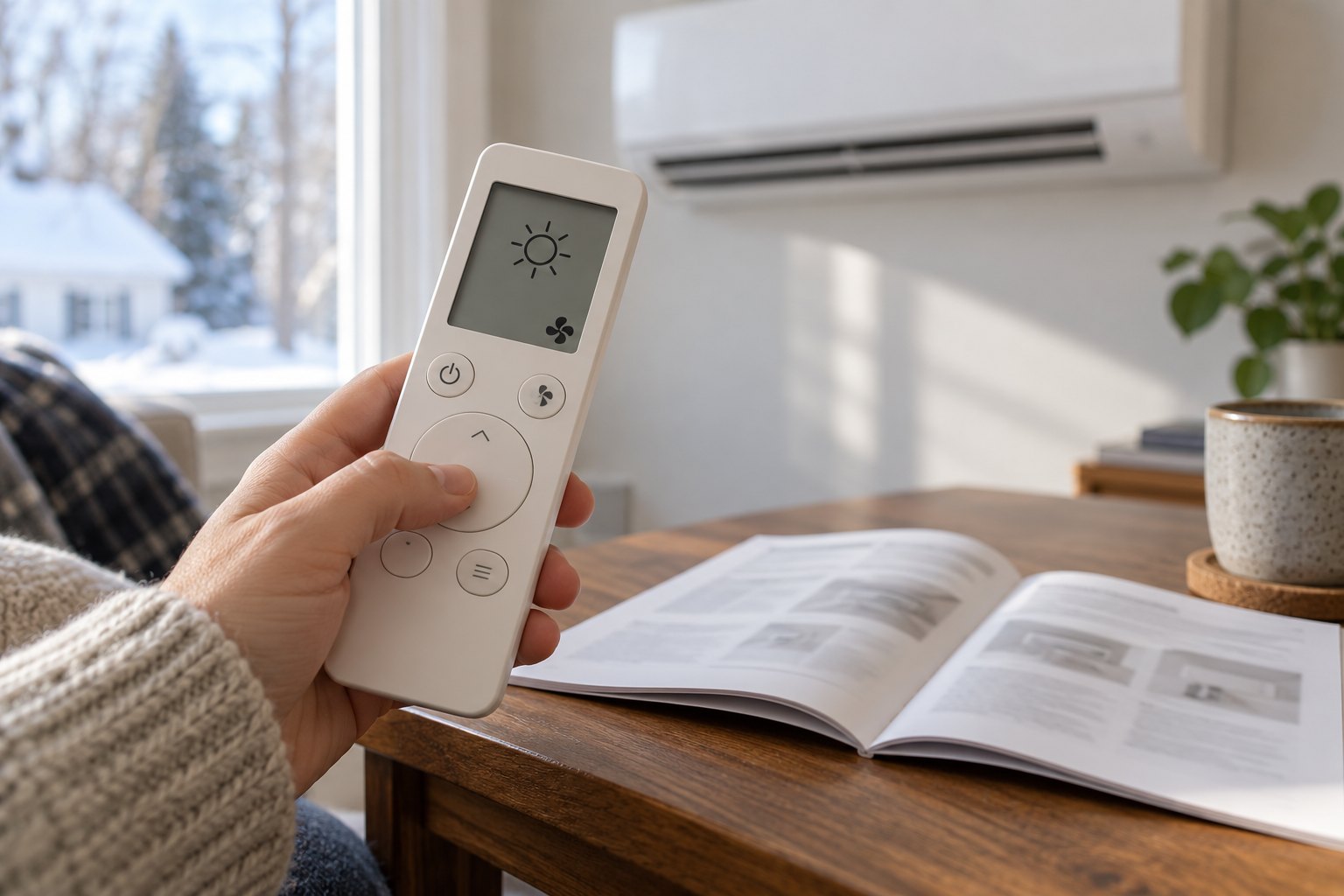
The remote has a sun, a snowflake, three arrows and enough buttons to run the T. Your room is still chilly. Before cranking every setting, separate the three controls that actually matter: operating mode, fan speed and temperature.
Cost: $0 for a settings check
Your practical checklist.
- Find the exact model’s user manual and identify mode, fan and temperature controls.
- Choose Heat for winter operation; do not confuse system Auto with fan Auto.
- Start with fan Auto, aim airflow into open living space, and check for obstructions.
- Record your comfortable setting and ask the installer about persistent trouble or backup-heat behavior.
Heat mode and fan Auto are not a contradiction.
The operating mode determines whether the unit heats or cools. Fan speed determines how indoor air is moved. Efficiency Maine recommends Heat rather than system Auto in winter, and suggests starting with fan Auto.
Look for separate controls in the manual. A photograph of your remote and the model number makes a service call much easier. Do not assume a setting on your neighbor’s ductless unit means the same thing on your central thermostat.
Try a steady setting before a big overnight setback.
Efficiency Maine’s user guidance favors a comfortable steady setting for heat pumps. DOE also cautions against manual setbacks that activate electric-resistance backup heat. That does not make every schedule wrong: controls, equipment and installer configuration matter.
Use this as a question for your installer, not a universal temperature prescription. Ask whether recovery from your current schedule brings on auxiliary heat and whether the thermostat supports heat-pump-specific recovery. Never disable backup protection or change installer settings just to make an indicator disappear.
Check maintenance without becoming the service technician.
Read the filter instructions for your exact unit. Some filters can be cleaned; others require replacement. Reinstall only as the manual directs. Leave refrigerant work, electrical compartments and internal cleaning to qualified service people.
Keep the outdoor unit’s required clearances clear of leaves and snow. Do not chip ice from the coils or pour hot water into the equipment. Repeated faults, loss of heat or abnormal ice buildup deserve a service call, not a YouTube adventure in a nor’easter.
Judge comfort where people sit.
A high-mounted unit may sense a different temperature from the couch. Put an ordinary room thermometer near the occupied area, away from direct airflow and sunlight, and compare at similar times. Record what the room feels like rather than chasing a number on the remote.
If you also have a boiler or furnace, ask how the two systems should work together and how pipe-containing areas remain protected. A comfortable upstairs room does not establish that the basement is safe from freezing. Your equipment plan needs to account for the whole house.
Build a useful record instead of pressing everything.
For a few ordinary days, jot down the operating mode, fan setting, target temperature and room temperature at a similar morning and evening time. Add whether the door was open and whether another heater was running. Change one ordinary user setting at a time, staying within your manual’s instructions. Otherwise, even a more comfortable room will not tell you which change helped.
Use that record when calling your installer: “Heat mode, fan Auto, room still below my comfortable temperature in the morning; here is the model and what the backup system was doing.” Ask what normal operation should look like for that installation. A helpful service conversation distinguishes a control misunderstanding from a maintenance or sizing question.
Common questions.
Is Auto mode bad in winter?
System Auto may switch between heating and cooling; fan Auto controls air movement. Identify which Auto setting you are changing before following general advice.
Should every heat pump stay at the same temperature overnight?
There is no universal rule for every installation. Steady settings are a useful starting point for many ductless systems; ask about your equipment, thermostat and backup heat.
Can I turn off my old boiler after installing mini-splits?
Do not assume so. Have the installer review backup heating and freeze protection for areas that the heat pumps may not adequately serve.
Sources and fact checks.
Published by The Heatah team. Guidance is linked below; no professional inspection of your home is implied.
- Efficiency Maine: Heat Pump User Tips · checked 2026-10-28
- DOE Energy Saver Guide: Heat Pump Tips · checked 2026-10-28
Original editorial illustrations created for The Log. These images do not depict a customer property, an actual inspection or a measured result.