
You opened the heating bill and briefly considered mailing it back with “absolutely not” written across the top. Fair. But before buying equipment or sitting in three sweatshirts, work out which number changed. A bigger bill is a clue, not a diagnosis.
Cost: $0
Your practical checklist.
- Gather two bills and note dates, units, unit price and separate charges.
- Compare periods of similar length; mark estimated readings and fuel deliveries.
- Use the calculator below to isolate a price-only change at the same consumption.
- Check weather and household changes before drawing an efficiency conclusion.
What did the price change cost?
Hold consumption constant and compare two unit prices. Defaults are hypothetical—not today’s oil prices. Use one consistent unit, such as gallons, kWh or therms.
Excludes fixed charges, taxes, tiered rates and changes in consumption. No equipment or Heatah savings estimate. Your numbers stay in this browser; this tool does not send or save them.
Start with units, not just dollars.
For electricity, look for kilowatt-hours and the applicable supply and delivery charges. For gas, identify the billed unit, which may be therms or another unit. For oil or propane, note gallons delivered and the per-gallon price. Do not mix units between bills.
Write the number of days next to each period. A longer billing cycle can cost more even with similar daily use. If one reading is estimated, keep that uncertainty visible rather than treating the total as a precise measurement.
Oil deliveries are purchases, not a month-by-month burn log.
A delivery invoice records fuel put into the tank. Unless you also know tank levels at the beginning and end of comparable periods, you cannot infer consumption just by comparing two delivery sizes. A smaller top-up after a short interval is different from a full fill after a long one.
The calculator uses a chosen consumption quantity to show arithmetic only. It does not estimate your tank level, forecast your use or tell you which heating system to buy. Use your invoice price; the example numbers are deliberately hypothetical.
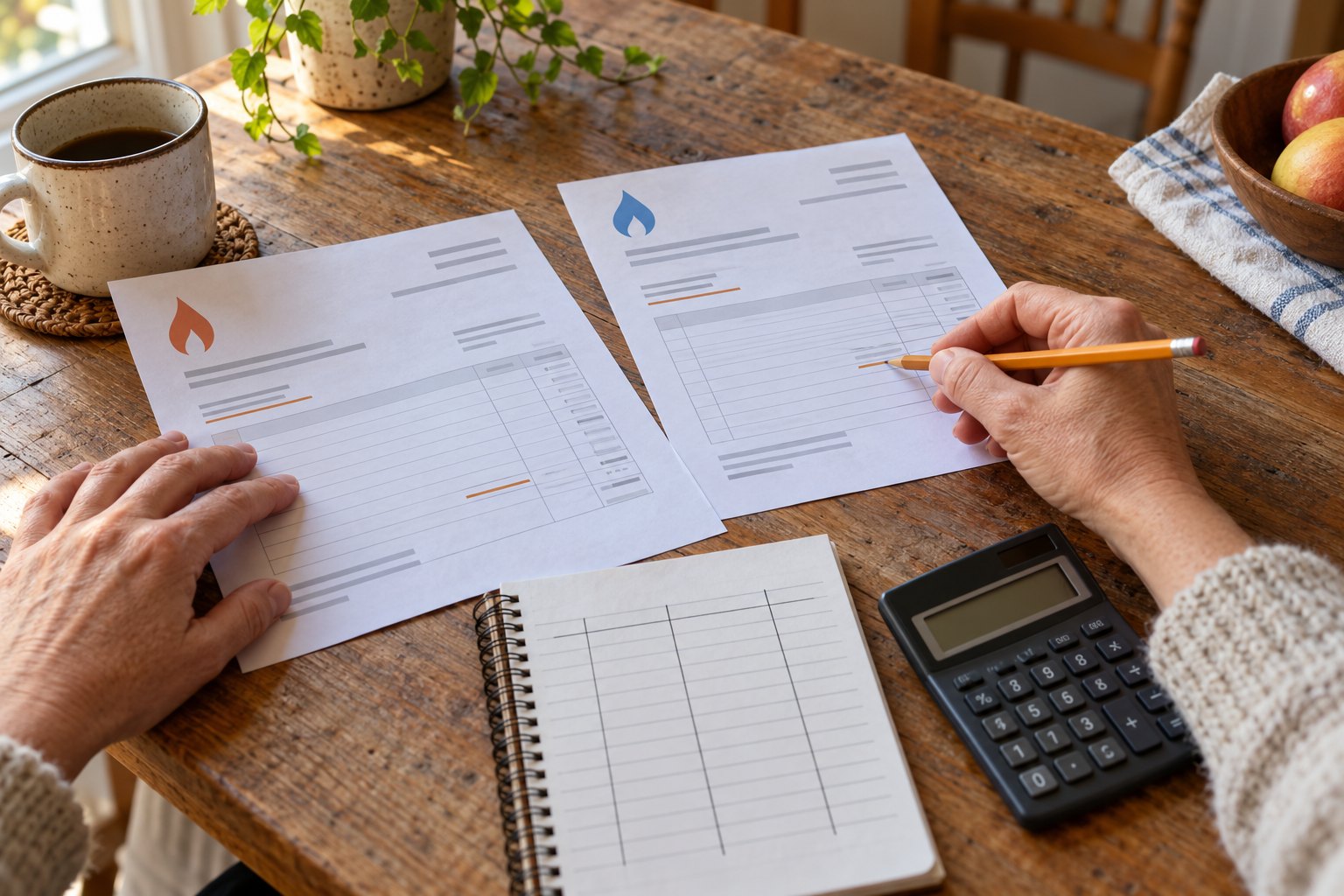
A price-only comparison makes the problem clearer.
Imagine the same 100 gallons at $4 per gallon and $5 per gallon. The energy charge moves from $400 to $500: $100 more with no change in consumption. That is a price effect. It does not prove your house became draftier.
Now imagine a different quantity, a colder period or extra occupancy. Those introduce separate effects. Keep a simple worksheet with one row for each factor so that a sales pitch does not turn several unknowns into one suspiciously precise savings promise.
Weather matters, even when the thermostat stays put.
EIA explains heating degree days as a measure of heating demand associated with cold weather. Colder conditions can raise demand without a thermostat change. Compare local weather over equivalent periods before deciding that a new habit or repair did nothing.
If usage rises persistently after accounting for dates and weather, ask your utility about billing questions and a qualified technician about equipment performance. An unexpectedly high bill is worth investigating; it is not a reason to shut off essential heat or gamble with frozen pipes.
Turn the bill into a four-line worksheet.
Write one line for the dates covered, one for billed units, one for unit prices, and one for the remaining charges. Add a note beside anything estimated or unfamiliar. For a simple per-unit charge, dividing units by billing days gives you a daily-use comparison; it still does not account for weather. For a tiered tariff, preserve the individual tiers instead of pretending one advertised rate describes the whole bill.
Here is a question worth asking the utility: “Which part of this increase comes from the rate, which from the quantity, and is either reading estimated?” For a fuel dealer, ask about the delivery interval and any fees separately. Keep the invoice, your notes and the answer together so next month’s comparison starts with evidence rather than another kitchen-table mystery.
Common questions.
Does a lower bill prove I used less energy?
No. Prices, fees, period length and weather can change the bill. Compare the actual units and relevant conditions.
Does this calculator predict Heatah savings?
No. It only compares user-entered energy prices at the same assumed quantity. It makes no Heatah performance or savings claim.
Are the example oil prices current New England prices?
No. The defaults are hypothetical arithmetic examples. Enter the prices from your own invoices.
Sources and fact checks.
Published by The Heatah team. Guidance is linked below; no professional inspection of your home is implied.
- EIA: Degree-days and heating demand · checked 2026-10-28
- Maine Department of Energy Resources: Electricity price components · checked 2026-10-28
- Maine Department of Energy Resources: Heating fuel price methodology · checked 2026-10-28
Original editorial illustrations created for The Log. These images do not depict a customer property, an actual inspection or a measured result.